
Welcome to
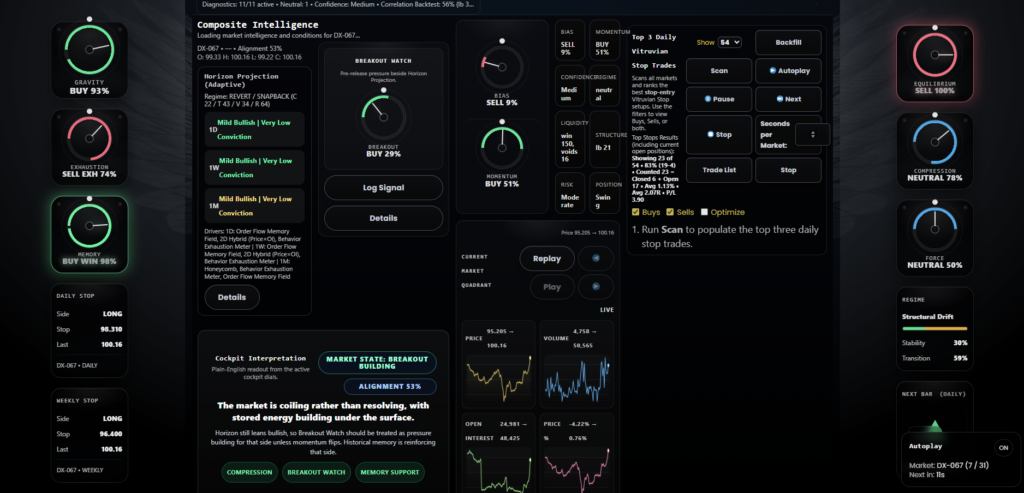
Glymear delivers a proprietary multi-engine analytical framework designed to reveal structural pressure, liquidity memory, volatility compression, and probabilistic projection — all in one unified terminal.
Built for traders who want more than price bars.
Our Approach
Why Choose Glymear for Thoughtful Market Insight?
Glymear offers a calm, reflective alternativeto traditional market platforms. We prioritize clarity over noise, insight over constant reaction. Whether you’re studying price, sharing perspective, or refining your approach, Glymear is a space where reflection and markets meet, taking a refreshing alternative to traditional social platforms. and charting platforms. Join us to experience a new way of connecting online.
Reflective Market Analysis
Measured Perspective
Clarity Through Reflection
- Run Scan to populate the top three daily stop trades.
| # | Market | Signal Date | Price | Dir | Bias % | Confidence | Regime | H Price | Return % | Win | Notes (autosaves) | Actions |
|---|---|---|---|---|---|---|---|---|---|---|---|---|
| No signals yet. Run Diagnostics, then click Log Signal in the Composite panel. | ||||||||||||
Loading…
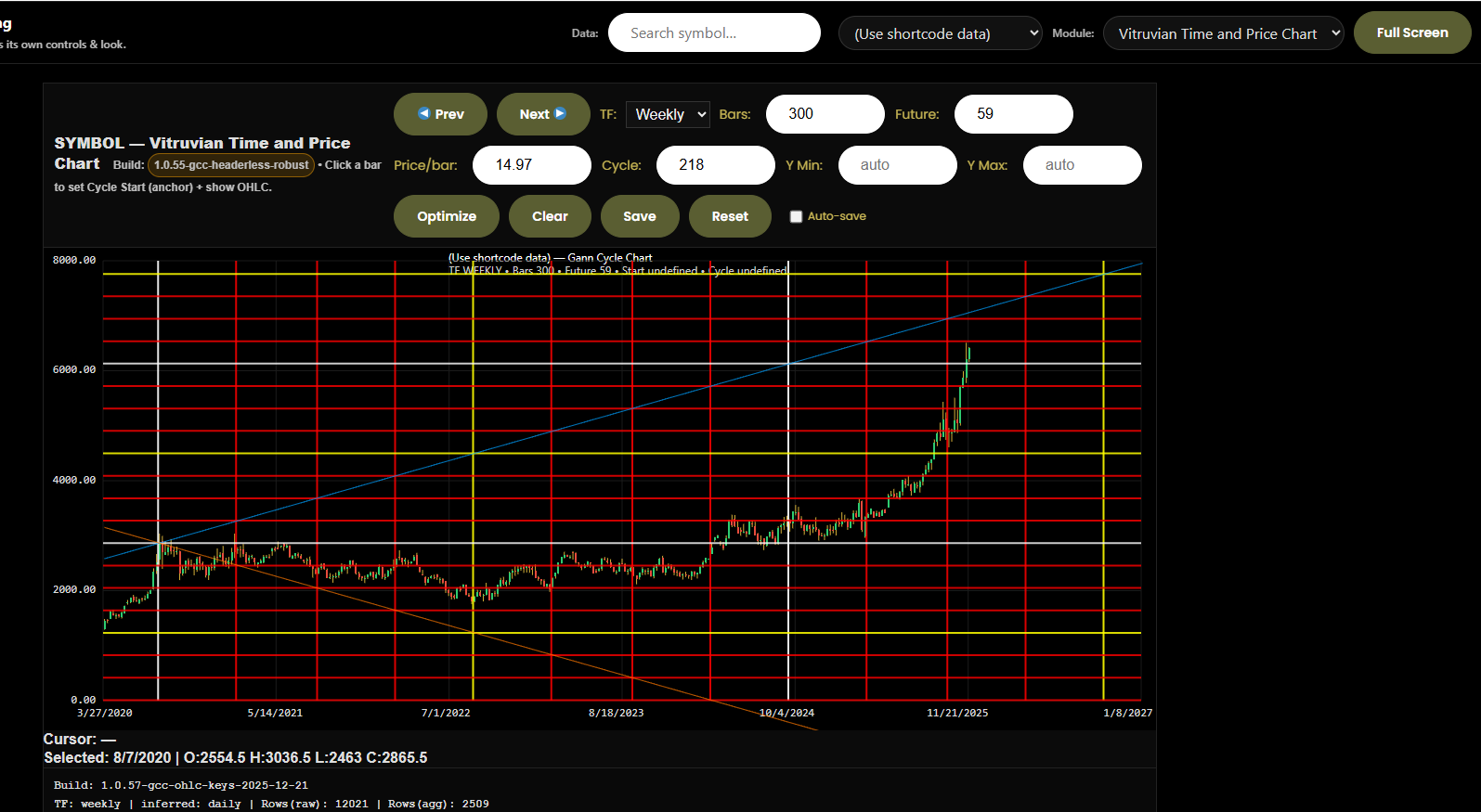
Vitruvian Time & Price
Overlays cycle geometry onto price so you can see repeating time/price structure. Adjust the cycle and where it starts to test different rhythmic partitions of the same data.
Inputs: Cycle = cycle length (bars). Start/Offset = where the cycle anchor begins. Divisions = how many partitions inside each cycle (2–12). Higher divisions = denser geometry.
Loading…
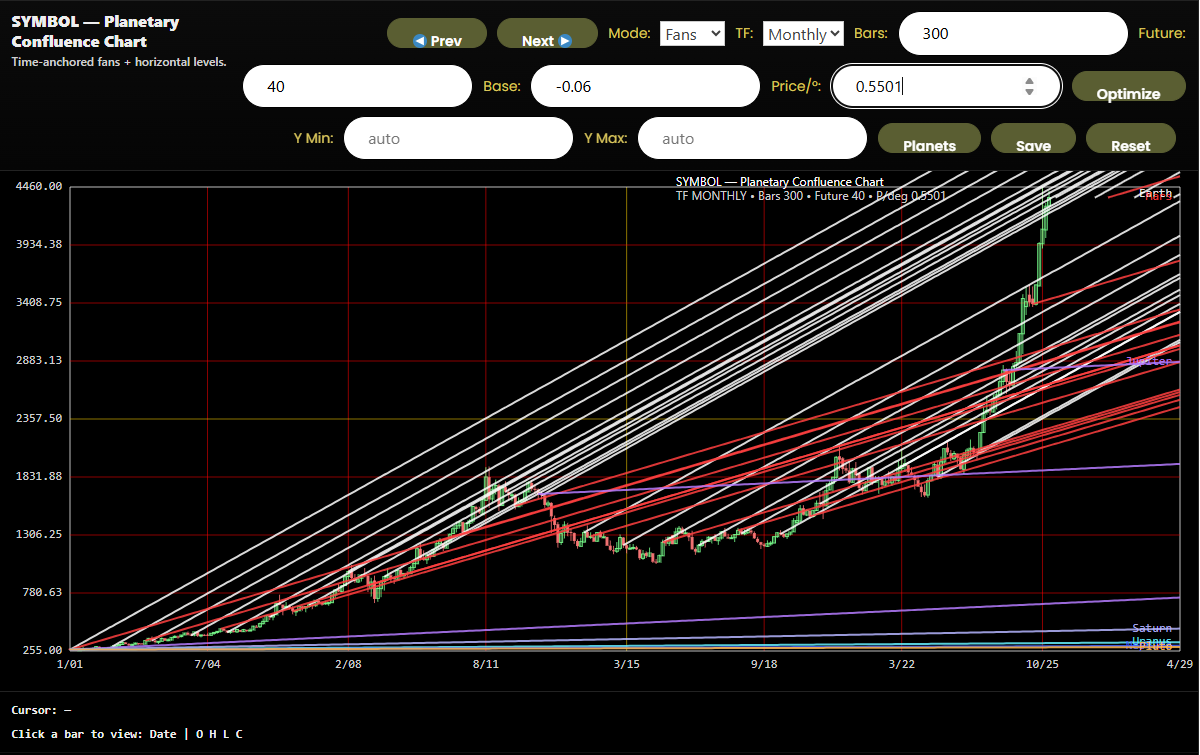
Planetary Confluence
Maps planetary timing into bar-index “event marks” and highlights periods where multiple cycles cluster. Use it to identify time windows of elevated confluence (potential volatility/turn risk), not direction by itself.
Inputs: Planet selections (where shown), TF, and any window controls on the toolbar.
Loading…
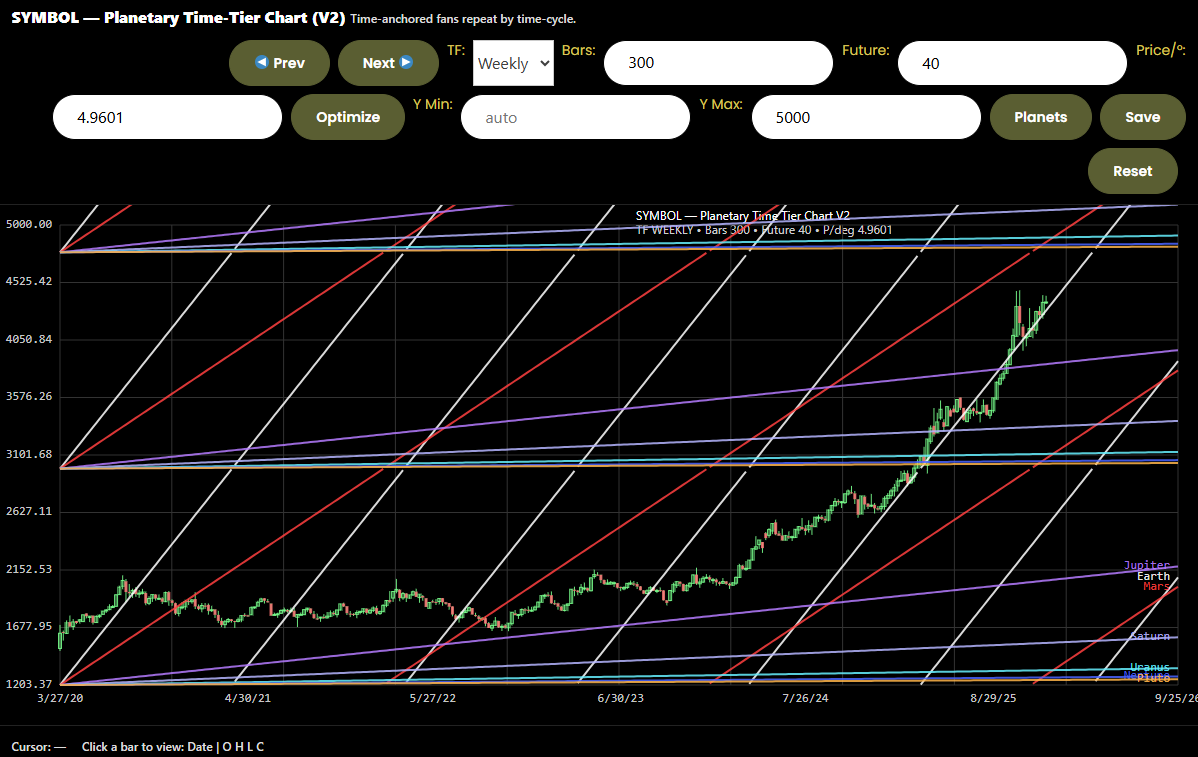
Planetary Time‑Tier (V2)
Builds horizontal price tiers (bands) derived from time/price harmonics. The tiers are “zones” where price often reacts, not exact single-price lines.
Inputs: Price/° controls tier spacing. Optimize auto-selects a spacing that yields about 3–4 clear tiers in the current view for readability. Bars controls the window.
Loading…
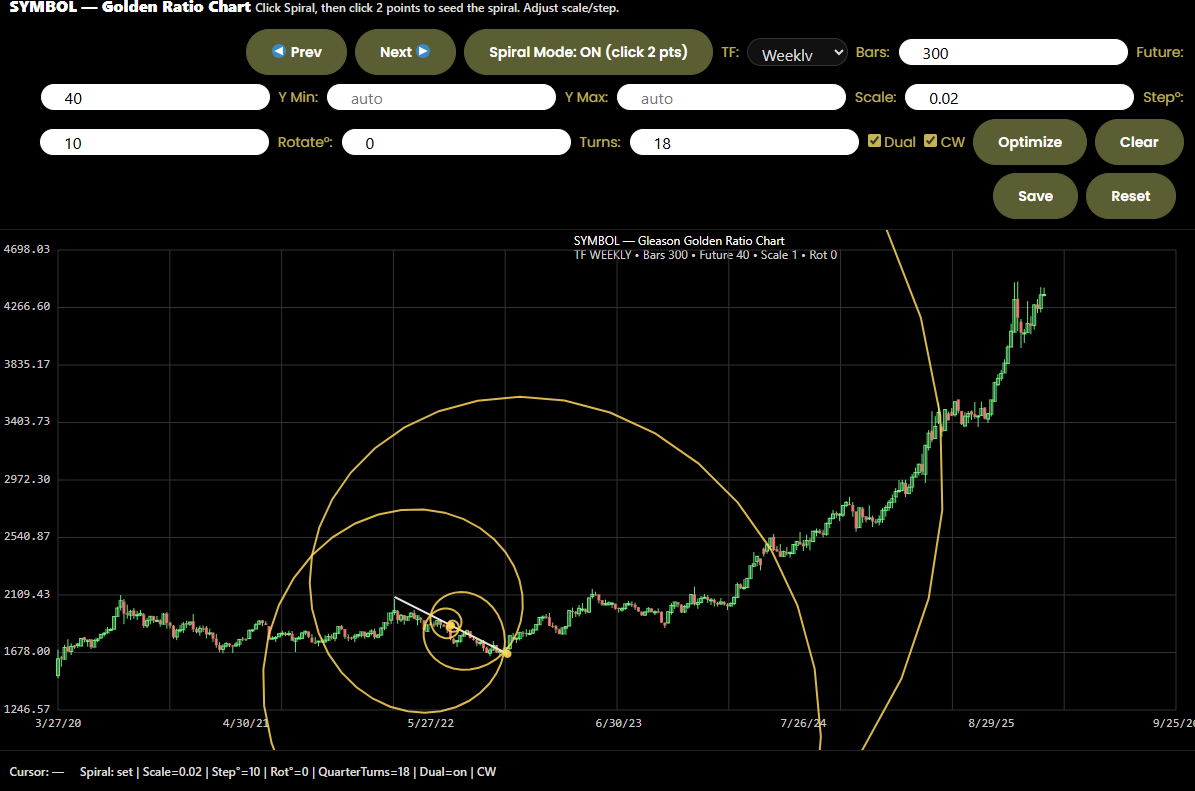
Golden Ratio
Projects proportional bands using φ relationships. Useful for measuring expansions/retracements around an anchor move and spotting proportional “steps” in structure.
Inputs: Anchor/window controls and scaling inputs shown in the panel.
Loading…
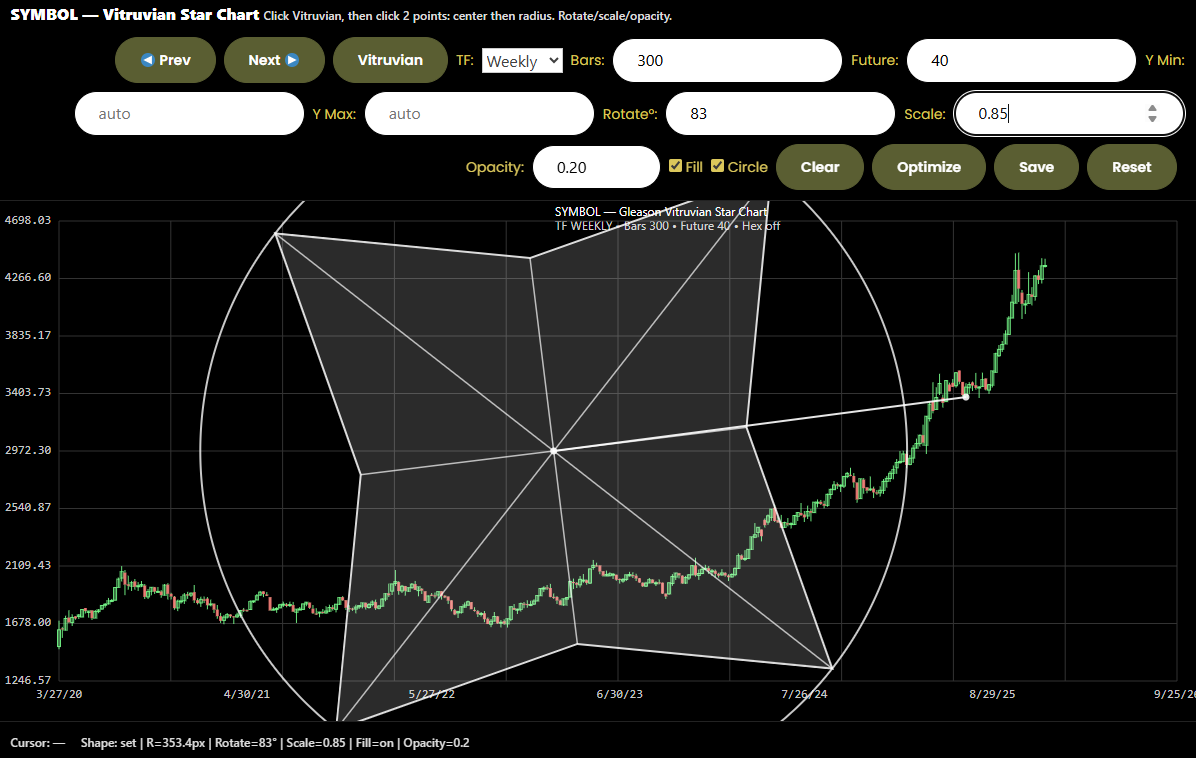
Vitruvian Star
A geometry-first cyclical view emphasizing symmetry and repeated partitions. Use it as a fast pattern lens when comparing different cycle lengths.
Inputs: Cycle/offset and star-specific controls shown in the toolbar.
3D Price Model
A lightweight 3D model of price through time. Drag to rotate and use volume depth to see “thickness” where activity increased. It’s a visual structure tool—pair it with Honeycomb/Stops for decisions.
Controls: Toggle Volume depth, adjust Z‑Scale, drag to rotate, wheel to zoom.
Loading…
3D Spiral Vitruvian (Classic) wraps time around a spiral while keeping price on the vertical axis. Use Bars/Spiral, Depth, and Rad Step to shape the helix; enable Cycle to overlay a tunable cycle on the spiral path.
Loading…
2D Hybrid (Price × OI) is the 2D companion to the 3D Spiral Hybrid. The top panel shows price; the bottom panel shows a hybrid “importance” curve (price weighted by Open Interest, or Volume). Use it to learn what the 3D peaks mean in a traditional chart view. Hover to read exact date + values.
Candles + OI‑Weighted Moving Averages
A traditional candlestick view with moving averages that can be weighted by Open Interest. Use it to separate “quiet” moves from moves supported by rising participation (OI build) and to see where OI contraction may be deflating trend strength.
Controls: Window navigation (Prev/Next/Jump), MA length/type (SMA/EMA/WMA), and OI weighting modes (none, OI level, ΔOI%, z‑score). Sensitivity sets how strongly OI affects the average; Clamp limits extreme distortion.
Loading…
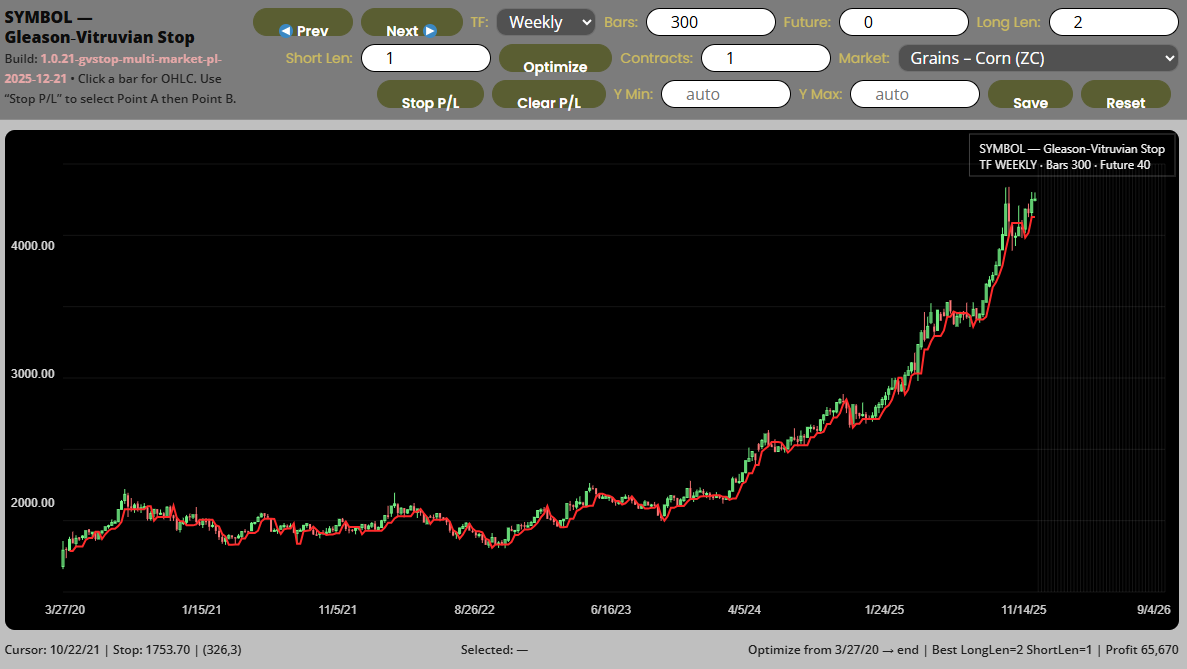
Gleason‑Vitruvian Stop
An interactive stop/flip framework based on recent structure. Use it to explore risk placement and structural invalidation levels. Always sanity-check with volatility and your market’s tick value.
Inputs: Long/Short lengths, offsets, and other stop parameters in the panel.
Loading…
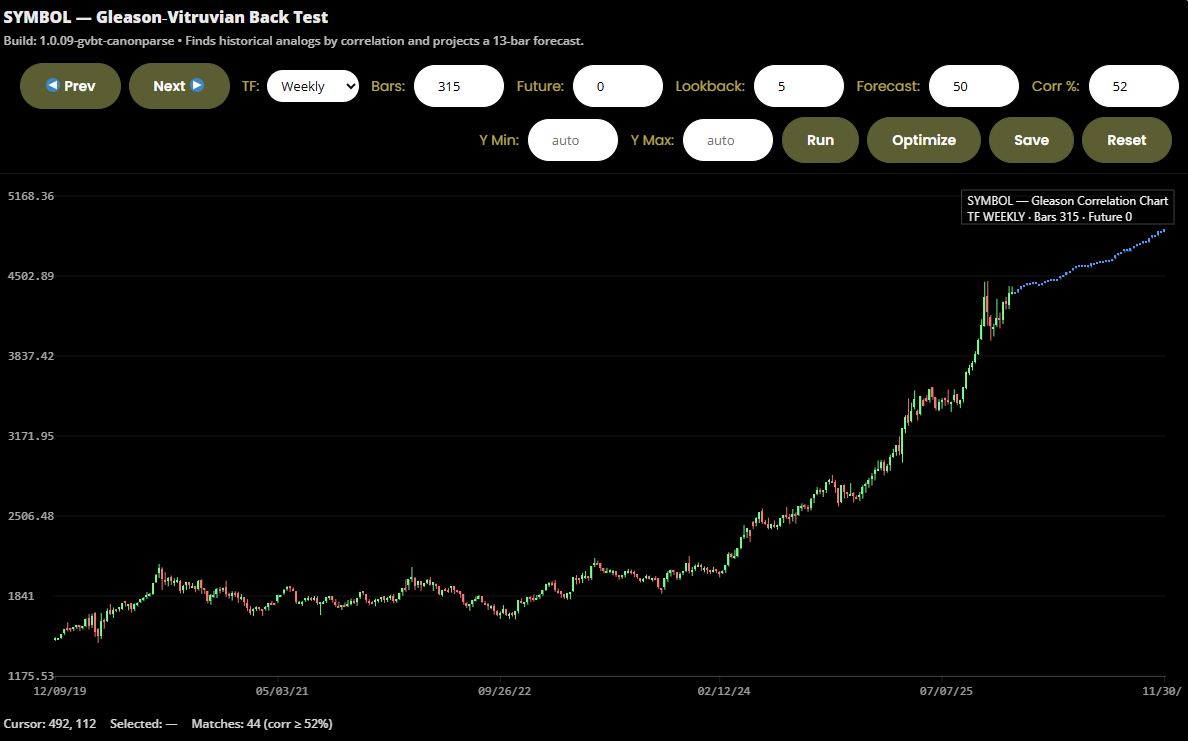
Vitruvian Correlation / Backtest
This tool searches for the closest historical analog window by correlation on Close price, then projects what happened next. Use it to explore “if this looks like that, what followed?” scenarios. It is a pattern lens, not a guaranteed forecast.
Inputs: Bars = size of the window being matched. Future = forecast length. TF = timeframe. Prev/Next steps through ranked analogs.
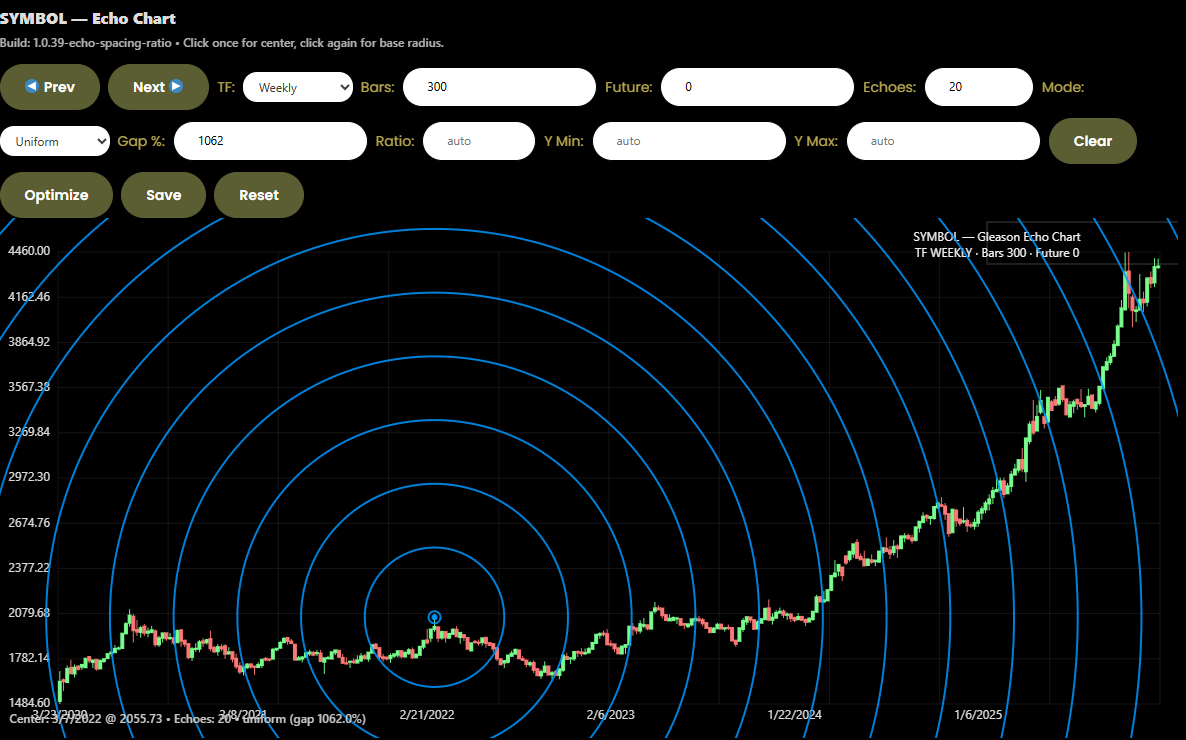
Echo Chart
Repeats (“echoes”) prior swing rhythm forward in time to visualize potential continuation of cadence. Use it to generate timing hypotheses, not certainty.
Inputs: Echoes = number of repeats. Mode chooses spacing behavior (Uniform vs Expanding). Gap %/Ratio control how spacing grows.
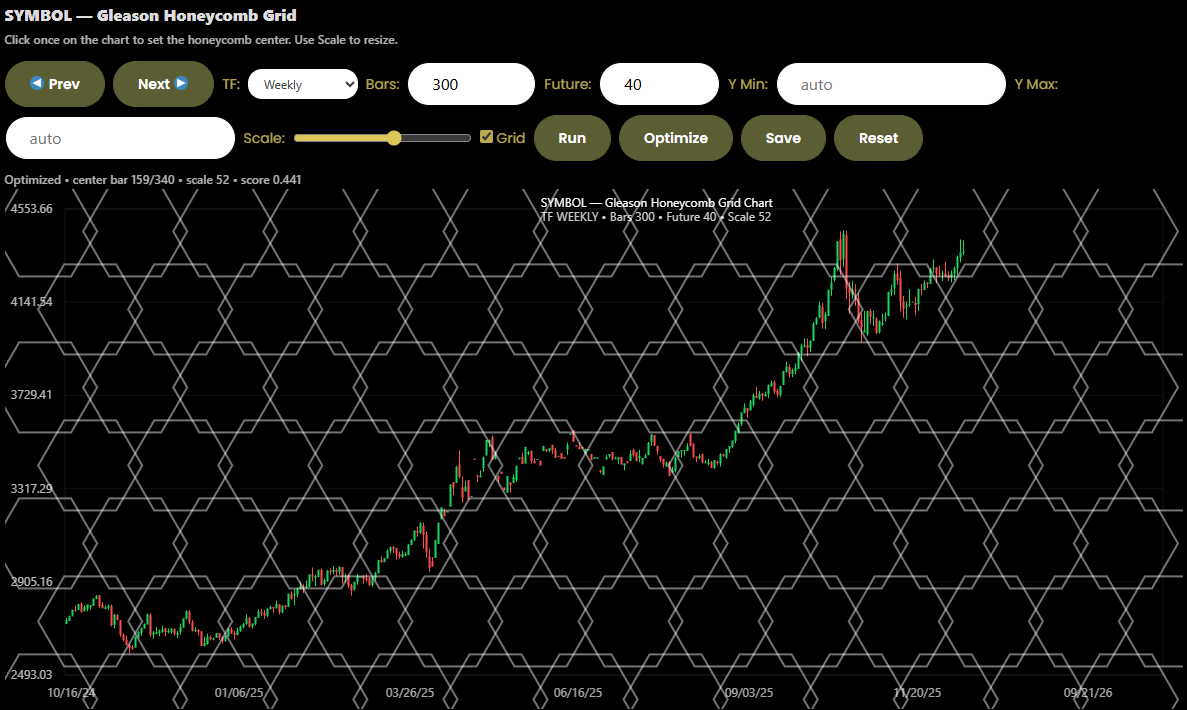
Honeycomb Grid
Plots a repeating lattice in price space from an anchor. It can reveal recurring reaction points, consolidation structure, and geometric symmetry. Best paired with trend/context from other modules.
Inputs: Grid spacing/scale, anchor controls, and window length as shown.
Order Flow Memory Field
Builds persistent “ghost levels” from absorption and rejection events. Nodes fade over time unless price revisits them (reactivation), creating a living map of where the market has unfinished business.
Controls: Detection thresholds (volume + body/wick structure), Half‑life decay, Tolerance (ATR/%), Touch boost, max nodes, and rendering options (band thickness, opacity, labels).
Fractal Compression Scanner
Measures multi‑scale range compression and volatility contraction. When compression aligns across scales, Pressure rises — stored energy that often precedes expansion.
Outputs: a Pressure score (0–100), multi‑scale compression lanes, and a Bull/Bear bias meter based on structure context (slope + VWAP position + micro‑structure).
Optimize: tunes scale set + compression mapping so the scanner best fits the current market window without curve‑fit “signals”.
Entropy Gradient Ribbon
Measures information entropy in recent returns to estimate order vs randomness. Low entropy tends to coincide with structured trend; high entropy tends to coincide with chaotic churn.
Visual: a flowing ribbon behind price whose thickness and intensity respond to entropy level and entropy slope.
Bull/Bear bias: combines trend slope with (1−entropy) so the meter reflects structure, not prediction.
Optimize: tunes entropy window + flat threshold + smoothing to best fit the current market window.
Behavioral Exhaustion Meter
Pairs with compression by estimating structural fatigue (topping/rolling risk) from multiple components: time spent outside VWAP bands, volume‑delta divergence, participation/OI stretch, and acceleration drop‑off.
- VWAP Win / Band×ATR: defines the mean and extension bands.
- Div Win: divergence window (returns vs volume‑delta proxy).
- Accel Win: acceleration fade window.
- Optimize: tunes windows/thresholds to maximize useful dynamic range.
Regime Signature Identifier
What it is: A self‑contained classifier that labels the current market environment ("regime") using structural features — not indicators. Think of it as the weather report for price action.
How to use: Use the regime label to decide which tools to trust. In a Structured Trend regime, bias + breakouts tend to follow through. In Entropic Turbulence, bias should be dampened and you should expect whipsaw. In Compression Coil, focus on pressure/force tools and wait for release.
- Regime: the current label + glyph (brandable "sigil").
- Stability %: how locked‑in the current regime is (higher = less likely to flip).
- Transition %: near‑term flip pressure (higher = likely to change soon).
- Bull/Bear %: directional tilt tempered by regime (chaos regimes dampen).
Key inputs:
- Window: how many bars define the regime snapshot (bigger = smoother, smaller = faster).
- Segments: splits the window into chunks to measure structural change.
- K (Clusters): number of regime "buckets". 5–7 is a good range.
- Weights: how much to emphasize Volatility vs Entropy vs Compression vs Force.
Optimize: tunes K, segmentation, smoothing, and weights so regimes are stable (no flicker) but still respond to meaningful shifts.
Probability Cone Projection Engine
What it is: A forward structural projection that draws inner/outer cones (≈68% / ≈95%) using volatility memory and regime context. This is not a trade signal; it’s a “most likely space” map for future price.
How to read: The cone widens in chaotic/high‑entropy conditions and tightens in structured/low‑entropy conditions. The cone can also tilt (skew) if force (acceleration) is persistent. When price rides the cone edge, you’re in expansion; when it mean‑reverts back toward the center line, you’re in digestion.
- Center line: expected drift (structure‑weighted), not certainty.
- Inner cone: tighter probability band (≈68%).
- Outer cone: wider band (≈95%).
- Bull/Bear %: projected skew (tilt) tempered by entropy (chaos dampens).
Key inputs:
- Horizon: how far forward the cone projects.
- Vol Memory: how many bars define current volatility (higher = slower, lower = reactive).
- Entropy Weight: how strongly disorder expands/shrinks cone width.
- Force Weight: how much acceleration tilts the cone.
- Gravity (VWAP): how strongly the cone’s drift pulls back toward mean.
Optimize: searches a small grid of horizon/memory/weights to produce a stable, readable cone for the current market window.
Liquidity Void Topology Map (3D)
Builds a 3D “terrain” surface where peaks represent liquidity magnet mass and valleys represent voids / imbalance. Rotate/zoom to see structure from multiple angles.
Surface components: volume density, time‑at‑price, rejection speed (proxy), and failed‑auction / excess tails (proxy). Mass is a weighted blend of these components.
Controls: bins, time segments, smoothing, component weights, Z‑scale, camera yaw/pitch/zoom, wireframe, and export PNG.
Nine Ways to Observe the Market with Clarity
Vitruvian Time & Price Chart Where Time and Price Meet Geometry
Vitruvian Correlation Chart See When the Market Remembers Itself
Planetary Confluence Chart Long Cycles, Quiet Influence
Planetary Time-Tier Chart Markets Move in Layers of Time
Golden Ratio Spiral Chart Growth, Expansion, and Natural Proportion
Vitruvian Star Chart Symmetry Reveals Hidden Balance
Gleason-Vitruvian Stop A Stop Designed to Follow Structure, Not Emotion
Echo Chart When Price Repeats Its Own Voice
Honeycomb Grid Chart Order Within Apparent Chaos
Community Highlights
Trading Risk & No Advice Disclaimer
Top Questions
- Deep questions about life and purpose
- Reflections on personal growth
- Thought-provoking insights from community members
Community Engagement
- Active community members
- Thoughtful question exchanges
- Meaningful reflections
Community Highlights
- Engaging questions and answers
- Community reflections
- Insightful discussions
Thought Trees · Questions · Reflections
-
Thought Tree
Thought Nathaniel Gleason December 18, 2025 -
Thought Tree
Thought zoritoler imol January 19, 2026 Just wanna remark on few general things, The website design and style is perfect, the articles is really fantastic : D.
-
Thought Tree
Thought zoritoler imol January 19, 2026 Saved as a favorite, I really like your blog!
-
Thought Tree
Thought zoritoler imol January 21, 2026 Wonderful blog! I found it while browsing on Yahoo News. Do you have any suggestions on how to get listed in Yahoo News? I’ve been trying for a while but I never seem to get there! Thanks
-
Thought Tree
Thought zoritoler imol January 21, 2026 I think other website proprietors should take this web site as an model, very clean and fantastic user genial style and design, as well as the content. You’re an expert in this topic!
-
Thought Tree
Thought 9jli8k4tj January 30, 2026 ahkxl4
-
Thought Tree
Thought ml817hlts January 30, 2026 z2c8kc
-
Thought Tree
Thought gl5m32s1k January 30, 2026 nrhfze
-
Thought Tree
Thought Michalak Aleksandra February 5, 2026 Good day.
My name is Michalak Aleksandra, a Poland based business consultant.
Running a business means juggling a million things, and getting the funding you need shouldn’t be another hurdle. We’ve helped businesses to secure debt financing for growth, inventory, or operations, without the typical bank delays.
Together with our partners (investors), we offer a straightforward, transparent process with clear terms, designed to get you funded quickly so you can focus on your business.
Ready to explore our services? Please feel free to contact me directly by email: [email protected] Let’s make your business goals a reality, together.
Regards,
Michalak Aleksandra.
Email:[email protected]
a chart of May corn prices